
The Garage Head Is the Weak Point on a North Syracuse House
Put the steel over your openings on the same list as the gutters, because nobody has ever told you it belongs there.
Lintel Repair quote in North Syracuse
Share a few details so we can confirm coverage and arrange the right next step.
Would you rather talk it through? Call (315) 640-3590, answered 24/7.
$100 off your first job
Credited by us on your first booked job.
- One credit per customer per property, on your first booked job.
- Valid through December 31, 2026.
Mention this offer when you book. Full terms.
Why a 1959 village leads with its openings
North Syracuse's median house dates from 1959, with 38.5 percent of its 3,072 homes built between 1940 and 1959 and only 14.9 percent before 1940. So the soft historic brick argument that dominates the old canal and salt villages is the wrong story on most streets here. What these houses have instead is bare steel over the windows, the doors and above all the garage, and the brick industry's own guidance says it plainly: in harsh climates a lintel that was not galvanized will require periodic maintenance to avoid corrosion. Almost nobody here has been told that.
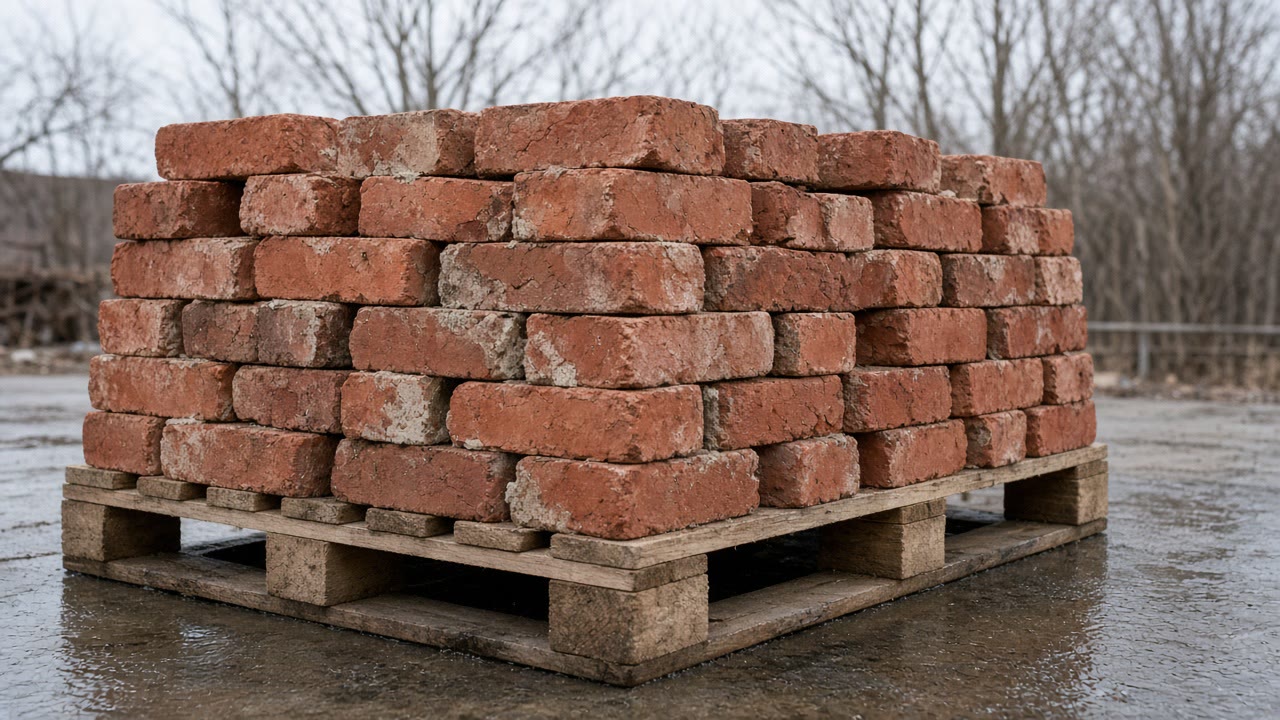
What lintel repair involves


Maintain it, or find out what it was sized against
Two conversations, and they cost very differently. The maintenance one is cleaning back surface rust and recoating steel that is still sound, which belongs on the same schedule as the gutters and the downspouts and gets priced like it. The other one starts when a head has deflected or the course above it has moved, and then the question becomes what the replacement is sized against. The published limit is a deflection no greater than one six hundredth of the clear span and not more than three tenths of an inch under combined live and dead load, and a garage opening is where that arithmetic bites.
A lintel belongs on the maintenance list
The brick industry says steel angle lintels should be at least a quarter inch thick with a horizontal leg of at least three and a half inches for nominal four inch brick, that galvanized steel should be considered in harsh climates, and that where it was not used the steel will require periodic maintenance to avoid corrosion. That is the cheapest masonry on your house.
The garage is the widest span you own
The same guidance says many cracks over openings come from excessive deflection caused by improper or inadequate design, that lintels should not be selected by rule of thumb, and that deflection should not exceed one six hundredth of the clear span or three tenths of an inch. Over a double garage that limit is a calculation, not a judgment call.
A village with a 1959 median build year
North Syracuse has 3,072 housing units, a median build year of 1959, 14.9 percent built before 1940 and 38.5 percent between 1940 and 1959. Within the Town of Salina next door, Galeville and Mattydale reach 60.7 and 54.6 percent for that same window. This is the steel lintel part of the county.
38.5 percent in the lintel decades, and the deflection limit
The Brick Industry Association's technical note on structural steel lintels states that the steel for lintels should as a minimum comply with ASTM A36, and that steel angle lintels should be at least one quarter of an inch thick with a horizontal leg of at least three and a half inches for use with nominal four inch thick brick. On maintenance it states that for harsh climates and exposures consideration should be given to the use of galvanized steel lintels, and that if this is not done then the steel lintels will require periodic maintenance to avoid corrosion.
Source: Brick Industry Association, Technical Notes 31B, Structural Steel Lintels, accessed 2026-09-10
The Brick Industry Association states that many of the cracks which appear over openings in masonry walls are due to excessive deflection of the lintels resulting from improper or inadequate design, and that the structural design of lintels should not involve rule-of-thumb methods or the arbitrary selection of structural sections without careful analysis of the loads carried and calculation of the stresses developed. Its serviceability limit is that lintels supporting masonry should be designed so that their deflection does not exceed one six-hundredth of the clear span, and not more than three tenths of an inch, under the combined superimposed live and dead loads.
Source: Brick Industry Association, Technical Notes 31B, Structural Steel Lintels, accessed 2026-09-10
The Town of Salina has 16,016 housing units with a median year of construction of 1960: 14.5 percent built in 1939 or earlier, 9.8 percent in the 1940s, 25.2 percent in the 1950s and 12.6 percent in the 1960s, so 35.0 percent of the town was built in the two decades from 1940 to 1959. North Syracuse village has 3,072 units with a median of 1959, 14.9 percent pre-1940, and 38.5 percent built between 1940 and 1959. Within Salina the census places of Galeville and Mattydale reach 60.7 percent and 54.6 percent for the same 1940 to 1959 window.
Source: US Census Bureau, American Community Survey 2020-2024 5-year estimates, table B25034 Year Structure Built and table B25035 Median Year Structure Built, accessed 2026-09-10
Which opening, and how wide is it?
Send the North Syracuse address with the opening width if you can measure it. The garage changes the arithmetic.
Openings: what North Syracuse owners ask
Can a steel lintel really be maintained rather than replaced?
Yes, and it is the cheapest masonry work on your house. The brick industry says that where galvanized steel was not used, and in the 1950s it mostly was not, the lintels will require periodic maintenance to avoid corrosion. In practice that means cleaning the rust back, recoating the exposed steel, keeping water off the top of the angle and pointing the joints above it. Done before the course lifts, it costs a fraction of a rebuild, and almost nobody is offered it.
How do I know whether my garage head was sized properly?
Ask what it was calculated against, and treat a shrug as an answer in itself. The guidance says lintel design should not involve rule of thumb methods or the arbitrary selection of sections without careful analysis of the loads and calculation of the stresses, and it sets the deflection limit at one six hundredth of the clear span and no more than three tenths of an inch. Cracks reappearing above a previous repair usually mean that step was skipped.
Get North Syracuse steel looked at while it is cheap
Surface rust over an opening, a step crack from a corner, a garage head bowing: describe it with the address, no obligation.