
Syracuse and the surrounding Onondaga County area
Lintel Repair and Cracks Above Windows, Doors and Garage Openings
Tell a rusting steel lintel apart from settlement, so the crack above your window, door or garage opening gets the trade it actually needs.
Lintel Repair quote
The useful quote here says how much steel is left and what goes over the new one. Tell us where the crack starts and whether there is a rust stain, and we will put you in front of licensed, insured contractors who look before they price.
Would you rather talk it through? Call (315) 640-3590, answered 24/7.
$100 off your first job
Credited by us on your first booked job.
- One credit per customer per property, on your first booked job.
- Valid through December 31, 2026.
Mention this offer when you book. Full terms.
The steel over the opening, and what it is doing to your brick
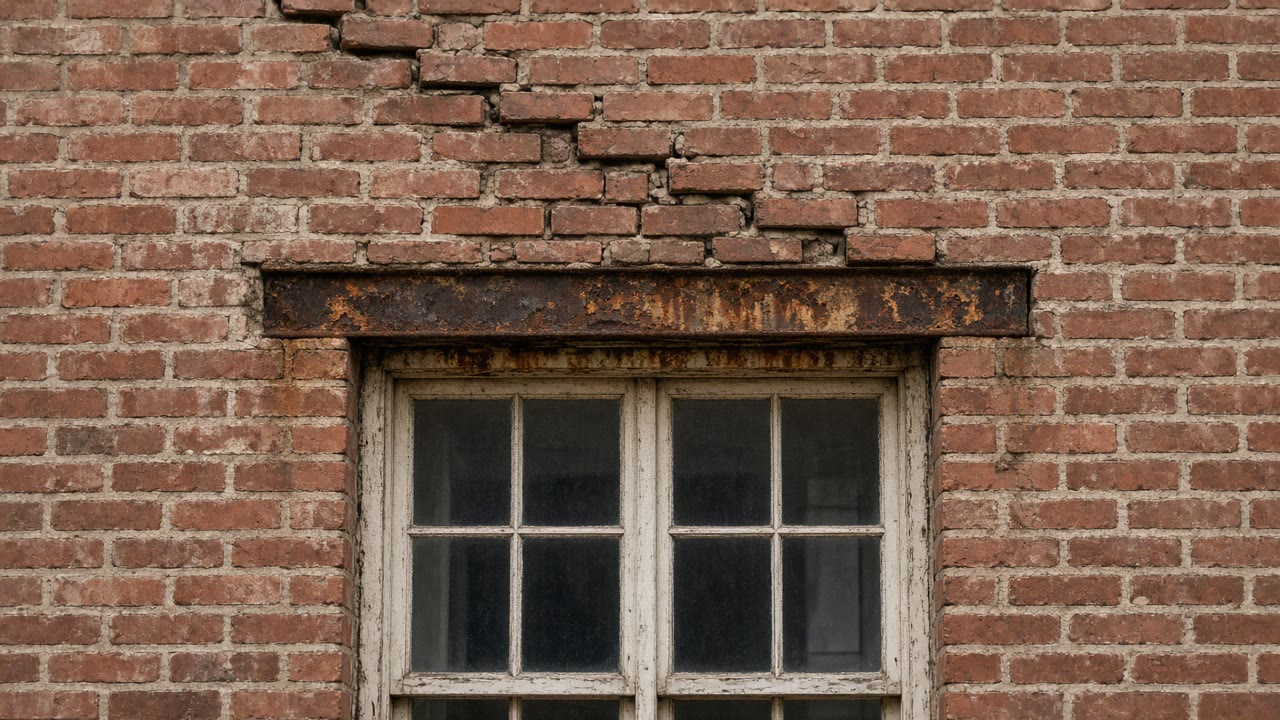
Almost every brick and brick veneer house here has a steel angle spanning the top of each window, door and garage opening, holding up the masonry above it. When bare steel corrodes it does not simply get thinner, it swells. Engineers at Wiss, Janney, Elstner Associates put rust scale at up to ten times the volume of the original metal, and a lintel enclosed by brick has nowhere to put that expansion except into the wall. So it lifts the course above the opening, opens the joints and drives a step crack diagonally up from the corner. That is why the crack over your window is not settlement, why it will not stay the size it is, and why filling it is the wrong move: sealing it keeps the water at the steel and the steel keeps growing.
- Diagnosing the opening from the outside signs, rather than treating every crack as foundation movement
- Removing rust scale to establish actual section loss, which is what decides repair against replacement
- Cleaning and recoating a lintel with surface corrosion that has not lost section
- Replacing a corroded steel angle, with the masonry above the opening taken down and rebuilt
- Sizing a replacement against the load and the clear span rather than by eye, which matters most over a garage
- Installing continuous flashing over the angle, between the steel and the brick facing
- Forming or reopening weepholes at lintel level so water that gets in has a way out
- Rebuilding the masonry around an opening with the additional ties the code calls for
- Repointing the joints above and around an opening, which is the treatment for the water reaching the steel
- Repairing the lintel and brick over a fireplace opening, where the steel is heated and cooled with every fire
What decides an opening repair
Two questions move this job: how much steel is left, and how much brick has to come down to reach it. Neither is answered by the width of the crack.
How much section the steel has actually lost
Visible rust is not a failed lintel, and this is the honest half of the story. The engineering position is that a significant accumulation of rust scale, while visually notable and damaging to the masonry touching it, does not necessarily mean enough original material has been lost to make the member inadequate, and section loss of 10 to 20 percent is the figure usually cited as the point to assess further. Where scale is extensive it has to be removed to find the real number. It cuts both ways: the expansion wrecks the brick long before the steel runs short of strength, so the cheap version of this job has an expiry date.
When the house was built
Steel angles over openings became standard in brick and brick veneer houses through the 1940s and 1950s, and that era maps completely differently across this county than old soft brick does. Ranked by the share of housing built between 1940 and 1959, the leaders are Galeville at 60.7 percent, Seneca Knolls at 58.9, Mattydale at 54.6, Westvale at 51.3 and Lyncourt at 47.1, with the City of Syracuse at 23.3 and Skaneateles village at 13.1. Skaneateles village is first in the county for pre 1940 brick and near the bottom for this. Which failure is likely on your street depends on which list your street is on.
Whether the crack is moving, and which way
The test is free and it comes from the National Park Service: mark the ends of the crack with a pencil, write the date beside it, and look again after a season change. A crack that widens in cold weather and narrows in hot is thermal and cyclical, and the published advice is a flexible sealant for an active crack and pointing for an inactive one. A crack that only ever gets wider is neither, and rust jacking only ever gets wider. Measured cases include a beam flange that grew from three eighths of an inch to one and five eighths, and masonry displaced three quarters of an inch.
How much masonry has to come down
Reaching the steel means taking the brick above the opening off and putting it back. The National Park Service's own remedy for cracking or displacement around an opening is replacing the failed components and rebuilding the area around the opening with additional reinforcing, not filling the crack. A wide garage opening is the expensive version of that sentence and a small window is the cheap one, which is why the number of openings matters less than which openings they are.
What goes over the new steel
This is the detail that decides whether the repair corrodes on the same schedule as the last one. The Brick Industry Association specifies continuous flashing over the angle, placed between the steel and the exterior masonry facing, with weepholes in the facing at lintel level so accumulated moisture can escape. The Residential Code of New York State requires flashing at lintels and at exterior window and door openings, and weepholes at no more than 33 inches on center immediately above the flashing. If a quote is only new steel and new brick, ask where the water leaves.
Whether it needs a permit, and it usually does
New York lets a municipality exempt repairs from needing a permit, but only where it wrote that exemption into its own enforcement program, and the exemption cannot reach work that has an impact on any part of the structural system. A lintel holds up the wall over an opening, so replacing one is not an ordinary repair however small the window is. Which counter you deal with is your village if the house sits inside an incorporated village and your town otherwise, and an exemption from a permit is never an exemption from the code that applies.
Rust stain, or a course out of level?
Either one moves this from a crack to a lintel, and it is worth knowing which you are looking at.
How an opening repair runs
Read the outside signs before opening anything
The steel is inside the wall with brick sitting on it, and ongoing corrosion can be completely concealed, so the diagnosis is made from what shows. A rust stain bleeding down from the top corner of the opening. A course above the opening that is no longer level. A step crack running diagonally up from the corner rather than up from the foundation. Put a level on the course directly above the window: if it has risen at the middle or at one end, the cause is under it, not under the house.
Separate a lintel problem from a foundation problem
The National Park Service lists corrosion of iron and steel wall reinforcement separately from differential settlement of foundations among the causes of cracking, and the two call for different trades. Settlement is a ground question. A cracked opening with a rust stain is a lintel question. Getting this wrong is how a homeowner pays the wrong contractor to solve the wrong thing.
Expose the steel and measure what is left
Rust scale has to come off before anyone can say what the member is. That is what separates cleaning and recoating a lintel with surface corrosion from replacing one that has lost 10 to 20 percent or more of its section. Location matters as much as extent, because loss at a bearing end is not the same problem as loss at mid span.
Take the masonry down carefully and keep what can be reused
The brick above a 1950s opening is rarely still in production. Salvaging the sound units for the visible face is usually the difference between a repair you can pick out from the sidewalk and one you cannot, and it is decided before the first unit comes off rather than after.
Size the replacement against the load and the span
The Brick Industry Association is direct about this. Many of the cracks that appear over openings are due to excessive deflection of lintels resulting from improper or inadequate design, and lintels should not be selected by rule of thumb or by arbitrary choice of section without analyzing the loads and calculating the stresses. Its serviceability limit is deflection no greater than one six hundredth of the clear span and not more than three tenths of an inch under combined live and dead load. A heavier angle picked by eye is how the same crack comes back.
Flash over the steel and give the water an exit
Continuous flashing over the angle, set between the steel and the brick facing, and weepholes at lintel level. New York's code requires both at that location and the brick industry's guidance asks for weepholes whether flashing is used or not. It also advises galvanized steel for harsh exposures, and says that where galvanized steel is not used the lintel needs periodic maintenance to avoid corrosion.
Rebuild the opening with the ties the code asks for
Openings greater than 16 inches in either dimension need additional metal ties around the perimeter, spaced at no more than three feet on center and placed within 12 inches of the opening. That is what keeps the rebuilt area from working loose again, and it is cheap while the wall is already open.
Repoint above and around the opening
This is prevention, not an add on. The engineering advice for limiting corrosion of steel engaged in a masonry wall is to keep the wall serviceable so less water gets into it, and it names repointing masonry joints, sealant repairs where appropriate and repairing cracks regularly. The joints are how the water reached the steel in the first place, so repointing above and around the openings first is what slows the thing lifting your brick.
What lintel repair looks like

Where opening repairs start and stop
When you may not need this at all
- A rust stained, scaling lintel with the brick above it still level and tight is a maintenance job rather than a replacement. Cleaning and recoating bare steel is cheap, and the Brick Industry Association's own position is that where galvanized steel is not used, steel lintels require periodic maintenance to avoid corrosion. Almost no homeowner has ever been told that, and it belongs on the same list as the gutters.
- A hairline crack over an opening with no rust stain, no lift in the course above it and no seasonal movement may need nothing at all. Mark it, date it, and look again after a season change. That is the same test the National Park Service recommends and it costs nothing.
- If the crack widens in cold weather and closes in warm, it is thermal and cyclical. The published advice for an active crack is a flexible sealant, not mortar and not a lintel. Pointing a moving crack simply cracks the pointing.
- If the cracking runs up from ground level rather than down from the corner of an opening, this is not the right service. That is a movement or settlement question and it is diagnosed and priced a different way.
- Cracked brick directly above a fireplace opening on the inside is worth showing to whoever quotes on the chimney rather than treating on its own. The code requires that masonry over a fireplace opening be carried on a noncombustible lintel with at least four inches of bearing each end, and cracking there points at that steel rather than at the flue.
What is out of scope
- Window and door replacement. The masonry over the opening is this job; the unit inside it is not.
- Foundation underpinning, piering and settlement stabilization.
- Structural design and stamped calculations. Where a span or a load needs a design professional, that is arranged separately and is not something this site provides.
- Filling or sealing a crack over an opening as a standalone repair where a rust stain or a lifted course says the steel is still growing. Sealing it traps the water.
- Timber header replacement in a frame wall. A steel lintel carrying brick over a garage opening is masonry work; a header behind siding is carpentry.
- Interior plaster and drywall repair where a wall has moved.
- Dry, uncontained grinding on a painted surface of a home built before 1978, which federal work practice standards prohibit without a shroud and HEPA collection.
Where we arrange lintel and opening work
- Lintel Repair in Syracuse
- Lintel Repair in East Syracuse
- Lintel Repair in Solvay
- Lintel Repair in Liverpool
- Lintel Repair in Skaneateles
- Lintel Repair in Camillus
- Lintel Repair in Salina
- Lintel Repair in North Syracuse
- Lintel Repair in DeWitt
- Lintel Repair in Clay
- Lintel Repair in Cicero
- Lintel Repair in Manlius
- Lintel Repair in Fayetteville
- Lintel Repair in Baldwinsville
- Lintel Repair in Marcellus
What people ask about cracks above openings
Is the crack above my window settlement, or something else?
Look at where it starts and what is beside it. Settlement cracking generally runs up from the foundation. Lintel cracking starts at the top corner of an opening and steps diagonally up and away from it, and it usually arrives with one of two other signs: a rust stain bleeding down from that corner, or a brick course above the opening that is no longer level. Put a level on the course directly over the window, because a lift of even a fraction of an inch tells you the cause is under it. The National Park Service lists corrosion of iron and steel wall reinforcement separately from differential settlement of foundations among the causes of cracking, and it names a different remedy for each, so this is worth getting right before you take a quote from anybody.
Why is filling the crack the wrong thing to do?
Because the thing that made it is still growing. Unprotected mild steel oxidizes rapidly when it gets wet, and the rust scale that forms can occupy up to ten times the volume of the original metal. A lintel is enclosed by brick, so that expansion goes into the wall: measured examples include a beam flange that went from three eighths of an inch thick to one and five eighths, more than four times its original thickness, and rust jacking that displaced adjacent masonry by three quarters of an inch. Three quarters of an inch is not a hairline, and it lifts a course out of level. Worse, the corroded surface is more porous, so it holds moisture and drives the next round of corrosion. Sealing the crack keeps the water where it is doing the damage and hides the next quarter inch of movement, which is why the published remedy is replacing the component and rebuilding around the opening rather than filling.
Does a rusty lintel always have to be replaced?
No, and homeowners are rarely told this. The engineering view is that significant rust scale, while visually notable and potentially damaging to the masonry in contact with it, does not necessarily mean enough original material has been lost to render the member inadequate, and section loss of 10 to 20 percent is the figure often cited as the point at which the element should be assessed further. Where scale is extensive it has to be removed to determine the actual loss, and both the location and the extent decide whether the answer is repair or replacement. So a stained, scaling lintel with the brick above it still in line is often a clean and recoat. The reason not to leave it indefinitely is that the expansion damages the brick well before the steel runs short of strength, so the cheap window closes first.
Why does this keep happening to houses of a certain age around here?
Because that is when steel angles became the normal way to carry brick over an opening, and because this climate supplies both things corrosion needs. Ranked by share of housing built between 1940 and 1959, this county's leaders are Galeville at 60.7 percent, Seneca Knolls at 58.9, Mattydale at 54.6, Westvale at 51.3 and Lyncourt at 47.1, and the corrosion literature specifically flags masonry buildings of the early 1900s onward where unprotected structural steel sits in contact with the exterior wall. Then the weather: a normal year here brings the daily low to freezing on 129.5 days while the daily high stays below freezing on only 45.7, so the temperature crosses in both directions about 84 times, and a normal 123.8 inches of snow melts into the wall while it does. That is a corrosion schedule rather than bad luck.
Will the repair just rust out again?
Only if nothing goes over the new steel, and that is the question to ask. The Brick Industry Association states that proper consideration must always be given to moisture control wherever there are openings in masonry walls, and that there must always be a mechanism to channel water in the wall to the outside. It specifies continuous flashing over the angle, between the steel and the exterior facing, and weepholes in the facing at lintel level regardless of whether flashing is used. New York's residential code requires flashing at lintels and at exterior window and door openings, and weepholes at no more than 33 inches on center immediately above the flashing. It also suggests galvanized steel for harsh climates and says that where that is not done the steel needs periodic maintenance. So if the answer to what goes over the new lintel is only steel and brick, you are buying the same failure with a later date on it.
Do I need a permit to replace a lintel?
Assume yes and confirm at the right counter. New York's regulation lets a city, village or town exempt repairs from its permit requirement, but only where the exemption is expressly set out in its own enforcement program, and the exemption cannot cover work that has an impact on fire and life safety such as any part of the structural system. A lintel holds up the wall above an opening, so replacing one is not an ordinary repair however small the window is. There is no single office for this metro either: the authority is your village if the house sits inside an incorporated village and your town otherwise, which is why Liverpool, East Syracuse, Solvay, North Syracuse, Baldwinsville, Fayetteville, Manlius, Camillus, Marcellus and Skaneateles villages each run their own counter separately from the towns around them. And an exemption from a permit has never been an exemption from the code that applies.
Tell us where the crack starts
From the corner of an opening, or up from the ground. That decides which trade you actually need.